Friday, August 3, 2018

easyJet (EJTTF) & Ryanair (RYAAY) Head-To-Head Review

easyJet (OTCMKTS: EJTTF) and Ryanair (NASDAQ:RYAAY) are both transportation companies, but which is the better investment? We will contrast the two companies based on the strength of their institutional ownership, earnings, risk, dividends, valuation, analyst recommendations and profitability.

Institutional & Insider Ownership

Get easyJet alerts:

43.8% of Ryanair shares are owned by institutional investors. Strong institutional ownership is an indication that large money managers, hedge funds and endowments believe a stock is poised for long-term growth.

Analyst Ratings

This is a breakdown of recent recommendations for easyJet and Ryanair, as reported by MarketBeat.

Sell Ratings Hold Ratings Buy Ratings Strong Buy Ratings Rating Score
easyJet 0 1 1 0 2.50
Ryanair 1 5 2 0 2.13

Valuation and Earnings

This table compares easyJet and Ryanair’s gross revenue, earnings per share (EPS) and valuation.

Gross Revenue Price/Sales Ratio Net Income Earnings Per Share Price/Earnings Ratio
easyJet $6.40 billion 1.36 $386.55 million N/A N/A
Ryanair $8.37 billion 2.81 $1.70 billion $7.05 14.25

Ryanair has higher revenue and earnings than easyJet.

Profitability

This table compares easyJet and Ryanair’s net margins, return on equity and return on assets.

Net Margins Return on Equity Return on Assets
easyJet N/A N/A N/A
Ryanair 18.47% 29.19% 11.34%

Volatility & Risk

easyJet has a beta of 1.29, indicating that its stock price is 29% more volatile than the S&P 500. Comparatively, Ryanair has a beta of 0.64, indicating that its stock price is 36% less volatile than the S&P 500.

Summary

Ryanair beats easyJet on 8 of the 10 factors compared between the two stocks.

easyJet Company Profile

easyJet plc, together with its subsidiaries, operates as an airline carrier primarily in Europe. As of September 30, 2017, it operated 862 routes and a fleet of 279 aircraft. The company also engages in the trading and leasing of aircrafts; and the provision of graphic design services. easyJet plc was founded in 1995 and is based in Luton, the United Kingdom.

Ryanair Company Profile

Ryanair Holdings plc, together with its subsidiaries, provides scheduled-passenger airline services in Ireland, the United Kingdom, continental Europe, Morocco, and Israel. It also offers various ancillary services, such as non-flight scheduled services and Internet-related services; and markets accommodation services and travel insurance through its Website, as well as engages in the in-flight sale of beverages, food, and merchandise. In addition, the company sells bus and rail tickets onboard its aircraft and through its Website; and markets car parking, attractions, and activities, as well as gift vouchers through its Website. It operates a fleet of 350 Boeing 737-800 aircraft and 33 leased aircraft; and offers approximately 2,000 scheduled short-haul flights per day serving approximately 200 airports primarily in Europe. The company was founded in 1985 and is headquartered in Swords, Ireland.


Sunday, July 22, 2018

Schnatter��s Shadow Shakes Shareholder Assurance

On today's episode of Market Foolery, host Mac Greer along with Motley Fool contributors Jason Moser and Matt Argersinger touch on some of the market's biggest stories. Domino's�(NYSE:DPZ) reported an unusual miss on their earnings, but investors shouldn't lose sleep over it. Papa John's (NASDAQ:PZZA), on the other hand, probably has some serious trouble brewing with their ex-CEO.

eBay (NASDAQ:EBAY)�had a rough quarter and blames it on a strengthening U.S. dollar ... but come on! Come on! American Express�(NYSE:AXP) is down on concerns over revenue and its market is getting tougher and tougher. Also, Matt and Jason talk about some fascinating companies they just pitched at The Motley Fool's quarterly board meeting.

A full transcript follows the video.

This video was recorded on July 19, 2018.

Mac Greer: It's�Thursday, July 19th. Welcome to Market Foolery! I'm Mac Greer. Joining�me in studio, we have Motley Fool analysts David Kretzmann and�Jason Moser. Guys, welcome! How are you doing?

Jason Moser: Doing great!

David Kretzmann:�Absolutely!

Moser: I'm�ready to wrap up the week here. You know, we're going to go pick up our daughters from camp on Saturday. They've been gone for three weeks straight. It's a preview�to the college years.

Greer: How�has that been for the kids, and how has that been for you and your wife?

Moser: The�kids have had a blast, I just spoke to them last night. It's funny, my wife and I made this point to each other, we had never had this long of a stretch together sans kids ever since they've been born. It's been wonderful to reconnect and do things and whatnot. But�we thought, even after 20 years, we're still not killing each other, I think we're in it for the long haul. It's all�working out well. [laughs]

Greer:�That's nice. That's a win-win. That's an earnings beat, is what I call that.

Moser: It is, it's�beating expectations and raising guidance.

Greer: We're going to talk about some companies that did not necessarily do that. On today's show, we're going to talk some�American Express, eBay and, guys, you're going to share a few stock pitches that you gave to our�board of directors yesterday.�

But let's start with pizza. Who doesn't love pizza? A rare earnings miss from Domino's. Domino's has been a monster stock over the years. Shares up�300% over the last five years, and 2,500% over the last ten years.�David, shares falling a bit today on disappointing revenue and�lower than expected same-store sales growth. Now,�they actually beat on the earnings front, but those other numbers weighing the stock down.

Kretzmann:�I think this is just a case where you have a company that has really high expectations. The underlying performance of the company is still undeniably very strong,�especially in the context of not only other pizza restaurants or chains, which we'll talk about, but also the restaurant space as a whole. As we know,�over the past few years, it's been very competitive and it's been difficult for companies to grow same-store sales,�let alone total revenue by�opening new stores. Domino's domestic same-store sales up 6.9%. You'd be�hard pressed to find any other restaurant putting up anything close to that. They had�4% international same-store sales, earnings per share up 35%. So,�I wouldn't be worried if you're a Domino's shareholder.

Greer: This is�just a matter of the bar being too high, or�unrealistic, do you think?

Kretzmann:�The�stock is only down 2% today, and�as you mentioned, it's had an incredible run this year and over the past two, three, five, ten years.�I don't think it's necessarily that expectations are too high,�it's just, the stock has done really well, and this is business as usual. For a company with expectations as high as Domino's,�sometimes business as usual is a little disappointing. But�if you're a long-term investor like us at The Fool, there's no reason to be worried here.

Moser: You know�that old saying, pizza does not grow to the sky.�

Greer: OK, wait a minute. [laughs]�

Moser:�It's trees.

Kretzmann:�I was going to say, I don't think I've heard that one.

Greer:�I hadn't heard that. I want to ask you about the longtime Domino's CEO,�Patrick Doyle, who just stepped down a few weeks ago. This guy is credited with�really turning Domino's around. In terms of my proprietary Mac Greer Humility Index,�he scores very highly. I don't have his exact number, but he was a guy who came out and said, "We hear you,�we know you think our pizza tastes like cardboard." Whether you think that or not, I think a lot of people agree their�marketing campaign was brilliant, and that he helped�turned the company around. Going forward, how much does it concern you that he's no longer there?

Kretzmann:�He said�one of his goals was to leave the company in good shape for his successor. In�this case, you have a new CEO, Rich Allison.�I think this was the first quarter where he had that CEO title. It'll be something for investors to watch. But, you look at the foundation that Domino's has today. They have�over 15,100 stores. Pizza Hut still has more locations worldwide, so�going forward over the next couple of years,�Domino's shouldn't have a very difficult time opening more stores. You want to continue to see�existing stores continue to perform well. We�want to see that same-store sales number continue to tick up. But,�you have to love the trajectory that the company is on. I think Rich�Allison, the new CEO, is in a good�position to continue the�momentum that Doyle put in place.

Moser:�I think, the one thing to look out for for Domino's --�I agree, essentially, he set this up so that�going forward, the new CEO,�don't change anything. Just keep doing what you're doing,�keep that ball rolling.�

Something that's completely out of their control is, we know that with all of�Papa John's woes, Pizza Hut is now�the official pizza of the NFL. We're going to see a lot more�Pizza Hut here in the coming months, toward the end of the year and the next year, as�football season kicks up. It's going to be something to watch here in the next few quarters,�to see if Pizza Hut doesn't have a little bit of a resurgence and�potentially take a little bit of share away from Domino's. It's�certainly a realistic possibility. Domino's, just don't change anything,�keep doing what you're doing.

Greer: You mentioned�Papa John's woes. Maybe Papa John's should hire Patrick Doyle. There's a free idea for you, turnaround specialist.

Moser:�[laughs]�Consultant Mac Greer.

Greer: There's a new twist in the Papa John's story. Last week, founder John Schnatter resigned as�chairman after admitting he had used the n-word�on a conference call. This week, Schnatter said�it was a mistake to resign. He said�the board's decision to remove him was based on "rumor and innuendo." And,�David, he owns 29% of the company's stock.

Kretzmann:�And�he's still sitting on the board. This is a little bit awkward. This�morning, Forbes came out with an article called "The Inside Story of Papa John's Toxic Culture,"�basically talking about a bro culture, big ego, and all sorts of things that Schnatter has been up to. It's like, that's supposed to happen in Silicon Valley,�not in Louisville. What are you doing, man?�

He�still has 29% of the company, he's still plastered on the pizza boxes and the marketing --�although, that's really been pulled back. Then, it's also come out this week that Wendy's (NASDAQ:WEN)�and Papa John's,�before all of this stuff came up over the past couple of months, they're�actually in talks to have some sort of merger. Going forward,�if you're the board of directors at Papa John's,�I think you have to really consider that possibility. Maybe�the best step forward for the company is to look for a merger or a sale, because, man, this seems like a train wreck that keeps accelerating.�When�you have Schnatter on the board, he would have to be in favor of a buyout or a merger for it to go through.�

Also, Major League Baseball suspended their partnership with Papa John's, so it's not just the NFL. The Papa John's name is coming off the University of Louisville football stadium. It really is a train wreck here. They�have to figure out something, quickly. To the board's credit,�they have acted pretty quickly to distance themselves from Schnatter, in terms of the marketing and the branding. But�Papa John's, John is still in the name,�the founder is still in the name.

Moser: Is�there a Papa John's bowl? You're talking about it coming off the stadium. Is there a bowl game? I think there's a Papa John's bowl.

Greer:�I'm not sure about that.

Moser:�I would imagine that's probably on the chopping block, as well.

Greer: Do�you have to, at some point, change the name of the company? Or, is this one of those stories where, for�the average buyer, if I'm looking at pizza and I like Papa John's Pizza -- as�my kids do -- this�story doesn't really matter that much? Or, at some point, are they going to have to change the name?

Kretzmann:�I think longer-term, they're probably OK with the name,�especially when you're taking Schnatter off of the marketing�and the branding. I would think, three years from now, you'd be fine, especially if they do partner with someone like a�Wendy's or some other restaurant chain.�

Right now,�Papa John's enterprise value is $2.3 billion. Buffalo Wild Wings was bought for $2.9 billion by Arby's. It's in a reasonable ballpark for some sort of acquisition or merger, so I would look for something like that over the next year.�I really think, going forward�as an independent company with Schnatter still�owning almost a third of the company and sitting on the board, that's�going to be a really tough situation to navigate.�

Someone�who I would love to hear from on this, who sits on Papa John's board�of directors, is�Texas Roadhouse�founder and CEO, Kent Taylor, who is�very much a straight shooter, as we know. We've interviewed him before. I would love to hear his perspective. He�also works in Louisville, and he's been involved with Schnatter and Papa John's for a while.�I'd be curious to get his perspective on everything that's going on�with the company -- because apparently, with this Forbes article coming out, there's�a lot of cultural and leadership issues at the company that�didn't just pop up in the past year or two. This has been going on for a long time.

Moser: It's important to note, too, that for everything that's gone wrong here -- I think the best thing they can do is get out of the headlines, in�one way, shape or form. Don't�let this thing keep dragging out through the headlines. But, for everything that's gone wrong, let's not dismiss the things that have gone right. They were�very quick to build a robust mobile presence. It's very convenient, very easy. They make a pretty good product. I think it would be very easy to get this thing out of the headlines,�keep focusing on what works for them, and�keep the business moving forward. The�problems that they have are extremely fixable. It sucks, but it's fixable. It�would be different if it was really bad pizza�and a really bad app�and a really bad brand. Right�now, they just have some identity problems.

Greer: Good�business. I think you bring in a new Papa John. It's basically how�Bewitched, back in the day, they switched key actors between seasons. I think, you bring someone new -- his name could be John, it doesn't have to be -- and you say, "This is Papa John." Patrick Doyle is Papa John.

Kretzmann:�Patrick Doyle joining, that would be awesome.�I do agree with JaMo -- when you look at Papa John's, their issues are fixable. What�makes this different from something like a Chipotle is, a�leadership change alone probably isn't the only thing you need. Schnatter in this case still owns so much of the company and still has so much influence. It'll�interesting to see how those dynamics play out,�but that's why I'm a little less optimistic about their�opportunities going forward as an independent company. If�you're trying to distance yourself from Schnatter, but he still has so much ownership and influence and control over the company,�those are tough waters to navigate.

Greer: Let's�switch gears here. Shares of American Express down on earnings. Jason, better than expected earnings here, but�some concerns over revenue.

Moser:�American Express has recently been lost in the conversation of modern-day money moving.�I think a lot of that had to do with its brand identity growing up. For�a long time, it has been a brand that's affiliated with�well-off people, or bigger spenders, perhaps. That's partly because of their closed-loop system. They have more control over the transaction from start to finish. Because�of that, they've historically been able to charge merchants more�in order to accept American Express.�

Now, the obvious question that comes from that is, if I'm a merchant, why would I bother paying more for�American Express if I have all of these other options out there? Customers are bringing Visa�(NYSE:V) and MasterCard (NYSE:MA),�and now PayPal (NASDAQ:PYPL)�and Square (NYSE:SQ)�and whatever else. Interesting, there was a lawsuit that tilted in American Express' favor here recently that�basically prohibits merchants from incentivizing customers to use other cards. That gives American Express at least a little bit of a leg to stand on in�charging those higher merchant fees.�

It's�not a bad business. It's a good business. But when you look at it in the context of the other opportunities that are out there --�Visa, Mastercard, those are bigger bases. Square, PayPal, far more advanced on the tech front.�PayPal is now a bigger company than American Express is, believe it or not. That�just came out of nowhere. It's not been the greatest investment to hold in the world. It's not a bad company, but if I'm looking in this space,�I just don't think American Express is really at the top of my list.

Greer: When�you look at the numbers here, David,�interesting, higher spending by the consumers, by small businesses, and by�corporate card members. But the kicker here is that those�higher spending numbers were partially offset by an�increase in the cost of rewards. They're really having to do more to compete. I can see that because I'm a happy, incredibly satisfied Chase (NYSE:JPM)�Sapphire Reserve card holder.

Kretzmann:�Me as well! It's�all about the points!

Greer: I love that card. You would have to pry that card for my dead, cold hands.

Moser: Is�that the Amazon (NASDAQ:AMZN)�Prime card?

Greer: No. [laughs]�Come on, man.

Moser: It's the Chase card. I have a Chase Amazon Prime card. I don't even understand what you're talking about.

Greer: Come on,�is that your child's credit card?

Moser: Wow!But, I think you make a good point --

Greer: [laughs] I'm just kidding. The Chase Sapphire Reserve card has incredible travel rewards, and that's why I use it. I transfer it to Southwest�and United�and all that good stuff.

Moser:�The�Amazon card's similar. You get these cash-back rewards for Amazon. Given that we already spend so much money on�Amazon's platform anyway, it's very convenient. But,�what I was going to say, I got an email from American Express recently. They were congratulating me for being a cardholder for ten years now. I thought, "Wow,�that was thoughtful!" But, you know what I noticed? In the last couple of years, when I got that Amazon Prime card, my�spending on my American Express card has curtailed significantly.

Greer: Interesting.

Moser: The rub here is, because I've had that card open for ten years, and�I have a good credit record, if I close it, that's not really a net win for me on the credit score side. So,�I'll keep it open, it's nice to have. But there's no question that my�spending has diminished considerably on that, and�much more of us spending now goes to that Chase Visa.

Greer: I'm sorry I talked trash about your Amazon Prime card.�I know people love it, I know people love the Amazon card.

Kretzmann:�Why not have both?

Greer:�I know. I just get a little enthusiastic about the Chase Sapphire Reserve.

Moser:�I appreciate your enthusiasm. Is that a Costco�card,�by the way?

Greer: It's�interesting that you ask, because now, yes -- I can use it at Costco, because they don't have their AmEx deal anymore! So,�it's just one more reason.

Kretzmann:�Can�you use any Visa at Costco?

Greer: I think so.

Moser: I think that was the straight-up Visa agreement. It really opened up the floodgates for Costco. Before,�the only card you could use was American Express.

Greer: Do you guys spend paper cash at all?

Kretzmann:�No.

Moser: Very rarely.

Greer:�I don't think our kids are going to know what it is.

Moser: Our kids do not carry cash around with them. Whatever they get, part of it goes into their investment account, part of it goes into their savings account,�they have a little bottle at home that they keep a little bit of spare change in, but�nothing much.

Greer: Can�your kids talk about the war on cash basket? I imagine that's a big conversation. Are�they conversing, talking about PayPal, Square?

Kretzmann:�Every night at the dinner table, "Daddy,�how's the war on cash basket doing?"

Moser: That is�one of the stocks on their radar. [laughs]�

Kretzmann:�Mac, it's�interesting, going back to the higher expenses related to credit card rewards, that has become such a competitive element for Visa,�MasterCard, and American Express. You and I are happy Chase Sapphire reserve customers. A year or two ago, their sign-up bonus was 100,000 points, which basically works out to $2,000-3,000. It's�not cheap. American Express has had to ramp up the rewards�in an effort to compete against the Sapphire Reserve card.�It'll be interesting to see how that all plays out.�

At this point, American Express is still the biggest of the three, of AmEx, Visa and MasterCard,�in terms of cash flow production. But�they also have the slowest revenue growth. At this point, you look at Visa and MasterCard, they're growing much faster, they tend to appeal more to a younger audience than AmEx. AmEx is really having to find some ways to appeal to a younger audience. In doing so, their expenses are rising, because they need to offer more compelling rewards to compete with those Visa and MasterCard offerings.

Moser: A couple of points to note with American Express.�American Express is a bank holding company, so it is going to be beholden to those bank capital ratios that Visa and MasterCard are not. It's not a bad thing or a good thing, it's just a different business.�

I feel like we're in the space where the costs of these services are coming down. American Express is going to have a tougher time proving their case that�they should be charging merchants more.�I just don't think merchants are going to be as�open-minded to paying more to accept�American Express when they can accept other cards, other payment forms, for less.

Greer: Guys, let's�talk some eBay. A rough day for eBay. Shares down around 9%�at the time of our taping. Jason, let's�look at the numbers here. We have disappointing full-year guidance and disappointing revenue.�eBay blaming the strengthening U.S. dollar,�which it says is hurting international sales.

Kretzmann:�Oh,�yeah, that's the reason. [laughs]�

Moser: That's what did it. [laughs]�

Greer: International sales�account for 60% of eBay's business.

Moser: Jeez,�eBay is in a really tricky situation. It's not really that it's a bad business, per say. It's�decent business. But it's really hard to come up with a compelling reason why anybody should invest in it.

Greer: It's�not the strong dollar? That's not the main problem? [laughs]�

Kretzmann:�[laughs]�If the�dollar was a little weaker, it'd be all about eBay.

Moser: When you talk about the problems that they need to solve, that's not really one of them.�I think a lot of this is summed up in a chart we saw on eMarketer the other day. It was talking about the top ten U.S.�companies ranked by retail e-commerce sales share in 2018. Amazon is now at 49.1% market share there. The closest competitor to Amazon is eBay. The bad news is, it's at 6.6%. 49.1% vs. 6.6%.�Then, you�keep on going down the line.�

The biggest surprise to me was Wayfair at 1.1%. You see what Wayfair has done as a stock�over the past year, it's been phenomenal. I think there's good reason for that.�I've certainly used Wayfair more than eBay.�

I think that eBay is just getting lost in the shuffle here. They're not doing any one thing really well. The StubHub acquisition is just, meh, it's�not really producing any meaningful top line growth for the company. Quarter in and quarter out, I'm just like, eh. It's�really a shame that they unloaded PayPal, because that was the crown jewel of that company,�in my opinion.

Kretzmann:�The capital allocation here is really baffling to me. What stuck out to me in the press release is that they're selling their $1.1 billion stake in Flipkart, which is�one of the larger e-commerce platforms in India. You compare that to October 2016, when they sold their 18% stake in�MercadoLibre. Since that time in 2016,�MercadoLibre has more than doubled.�

To me, what would be an interesting angle for eBay is�if they were investing in these different brands internationally�rather than trying to go it alone like they've done in the U.S. To me,�it would be more appealing if they did have some partnerships and stakes in some of these up-and-coming e-commerce platforms in Latin America and India. Instead, they're selling it off, they're trying to go it alone. To me, then you're competing directly against�Amazon and these local players.�I don't have a lot of confidence that eBay can make a better stand-alone platform,�because it's not really working even here in the U.S.�Within the U.S., I feel like they could go after an�Etsy�or a Wayfair and really bolster their e-commerce platform and do something different�from what Amazon or some of these other players are doing.�

So,�from a capital allocation perspective,�getting rid of PayPal, selling off MercadoLibre,�now selling off Flipkart, it makes me really wonder what the long-term strategy is here. I don't see how this wins against Amazon or�some of these other local players long-term.

Greer: It�sounds like the long-term strategy might be for the U.S. dollar to weaken.�

Kretzmann:�[laughs]�That's it!

Moser: [laughs]�Currency�effects as a strategy.

Greer: Guys,�as we wrap up, we had our Motley Fool quarterly board meeting yesterday.�I have it on good source, I have some people out there that have told me,�maybe some people in this room, that�you had an opportunity to pitch some of your favorite stocks�to our board of directors.�I want to recreate that magic,�because most of us were not there at the board meeting. Jason Moser,�I want to first of all hear what your stock was,�and then maybe give the quick pitch.

Moser: Sure.�I had to bring the heat this time around,�because we did it a quarter ago and I pitched Teladoc (NYSE:TDOC). I set the bar high, given where that stock has gone.

Greer: You mention Teladoc almost as much as I mention Costco, is that fair?

Moser: Yes,�I think that is fair. Maybe there's an advertising partnership there.

Greer: This is�the first time I mentioned Costco in this show. This is probably the latest I've gone into a Market Foolery.

Moser:�I prompted you mentioning Costco, too, if I'm not mistaken. Really,�you didn't do it, I pushed you to do it.�

Greer: It's OK.�I'm still feeling bad that I ripped on your Amazon card. I'm sorry. I'm sure it's a great card.

Moser:�[laughs]�Bezos will be coming after you.

Greer: Believe me,�I know. That's what I'm really afraid of.

Moser: This time around, I went with a name�I think a lot of our listeners will be very familiar with, Ameris Bancorp (NASDAQ:ABCB). A little small-cap bank�down in Southwest Georgia, Moultrie, Georgia,�where my mom and dad live.�I discovered this as a stock, I was looking at it back in late 2010, when the�financial crisis was really taking it to town on a lot of these little banks. It became very clear that Ameris Bancorp was a baby being thrown out with the bathwater. A very well-managed bank, small community bank,�but the FDIC found them as a partner to help roll up a lot of these failed institutions with basically risk-free acquisitions. Ultimately,�what that ended up doing is, it took the bank from a total base of assets of around $2.5 billion�back in 2010, they're�going to close out this year with close to $12 billion in total assets.�

One way to value banks is based on return on assets. They've been very good at consistently displaying good return on assets here, year in and year out.�I think we're entering a stretch where it's going to be very favorable for banks. As�interest rates continue to rise, they're going to be able to make a little bit more money on that net interest income line and�continue to do smart lending with a community focus. I think that Ameris Bancorp, ticker ABCB, still has plenty of room to run.

Greer: David Kretzmann?

Kretzmann:�I'm going with�Namaste Technologies. This is a small-cap�Canadian company. This is a cannabis e-commerce company. They have 32 websites in 20 countries. They�mainly sell vaporizers, hardware, and�other accessories. They're not actually selling the plant or oils yet.�Worldwide, they have 1.5 million registered users, 600,000 monthly visitors to�all of their different sites around the world.�

I like the fact that the two co-founders, they're still with the company, they own about 5%. Something that really stuck out to me is two board members they have. They have the product manager at Google's Waymo, and they have the former 10-year CIO at SpaceX -- basically Elon Musk's right-hand man. These two heavy hitters in the tech space, of all the companies they could choose to join and be on the board of, they�chose this $400 million Canadian cannabis e-commerce company. I think that's noteworthy, if nothing else.

The balance sheet is pretty strong. They have over $50 million in net cash. They're�still unprofitable and burning cash right now. This is�definitely still on the riskier side of the spectrum. But looking at this emerging cannabis opportunity worldwide,�I like the fact that they already have some traction with 1.5 million registered users.�

Also,�earlier this year in Canada, they launched the Namaste MD app. This is a telemedicine app. We were talking about Teladoc earlier. Namaste MD is an app you can download on your Apple or Android device, and you can have a free virtual consultation with a licensed healthcare professional. Rather than going to a brick-and-mortar clinic�in an attempt to get a medical cannabis prescription, where�you're not necessarily sure if the doctor even likes medical cannabis or will give you a prescription, instead, you can do this virtual consultation,�get your prescription online in just a matter of minutes. Then,�from there, you can go fill your prescription online through�one of Namaste's licensed producer partners.

A riskier�company, but I think in the grand scheme of things, with this cannabis category, this is an interesting one to keep an eye on.

Greer: I want to give a shameless plug. Now that you mentioned cannabis -- I never thought I'd find this connection here -- on this week's Rule Breaker Investing with�David Gardner, we did a blast from the past episode. If you've heard the podcast before,�there have been a couple of times where we've gone back.�Tom and David Gardner used to host a radio show, and we go back to some of our favorite interviews and play some of those clips.�

One�of the clips is from Cheech Marin, who is half of the long-term comedy duo Cheech and Chong. He's known for�a lot of his voiceover work, but also known for the movie Up in Smoke, and known for talking a lot about cannabis and marijuana. In 2002,�we basically asked him about marijuana -- buy, sell, or hold the legalization of marijuana. I won't give it away, but I will say Cheech was incredibly prescient. He called it, he saw the future before it happened.

Moser: But,�you're not going to give it away.

Greer: I don't want to give it away, but I think I just gave it away. [laughs]�

Kretzmann:�How did he see the future? I wonder if it was a substance he was using.

Greer: Yes. Maybe he was an investor in that. [laughs]�

Kretzmann:�Who knows? [laughs]�

Greer: That's a shout-out. There are a lot of other great clips on Rule Breaker�Investing. We�reflect back on an early Howard Schultz interview from Starbucks, Billie Jean King, Bob Geldof, humanitarian member of the�Boomtown Rats, some great stuff. Give Rule Breaker�Investing a listen when you get a chance.�

As always, our�wonderful, incredible listeners can email us here at marketfoolery@fool.com with their�questions, with their comments.�Jason, sometimes they're not just emailing us.

Moser: No. Sometimes they're going above and beyond and sending us what they do so well. I want to give a quick thanks to Adeeb at Cafe Hanna in Scotts Valley, California. He went through the trouble of actually packaging up some of his�proprietary hot sauce to send me. He knows from listening that I'm a cook, I like to cook,�I like to try new things with food. He went through the trouble to get me some of his famous hot sauce. That�stuff was just so good. If I'm ever out that way, you can rest assured I'm going to give his restaurant a shot. It looks like a Greek fusion restaurant; the menu looks amazing. Adeeb,�thank you very much. We appreciate it.

Greer: Strong buy.

Moser:�Very.

Greer: Guys, thanks for joining me!

Kretzmann:�Thanks, Mac!

Moser: Thank you!

Greer: As always,�thanks for listening to the show. Chris Hill will be back in the saddle next Monday --

Moser: Who?

Greer: Yes, Chris is back.

Kretzmann:�He still works here?

Greer: Yes. Hold off on any�angry emails. You don't have to worry. Chris will be back on Monday. Thanks, as always, for listening! As always, people on the show may have interests in the stocks they talk about, and The Motley Fool may have recommendations for or against, so don't buy or sell stocks based solely on what you hear. That's it for this edition of Market Foolery. The show is mixed by Dan Boyd. I'm Mac Greer. Thanks for listening! We'll see you on Monday!

Friday, July 20, 2018

What's Behind PTC Therapeutics' 10% Rally Today

What happened

PTC Therapeutics (NASDAQ:PTCT)�shares are rallying 9.5% at 3:30 p.m. EDT on Friday after the company announced it will acquire the gene therapy biotech�Agilis Biotherapeutics to get its hands on�GT-AADC, a clinical-stage therapy for patients with a rare central nervous system (CNS) disorder.

So what

PTC Therapeutics already markets the Duchenne muscular dystrophy drug Translarna in Europe and recently reported intriguing data for a drug that could win a green light for use in spinal muscular atrophy (SMA) someday.

An ascending bar chart overlaid on top of a monitor displaying stock prices.

IMAGE SOURCE: GETTY IMAGES.

After the closing bell on Thursday, PTC Therapeutics announced it's further expanding its product pipeline by acquiring Agilis for $50 million in upfront cash plus $150 million in stock. Agilis owners also can collect up to $60 million in development milestones over the next two years and up to $535 million in future regulatory milestones. If Agilis' drugs win the regulatory green light, PTC Therapeutics will pay tiered commercial sales milestones of $150 million, plus 2% to 6% royalties on net sales for Agilis' earlier stage therapies for�Friedreich ataxia and Angelman syndrome.

The most important therapy PTC Therapeutics nets in this deal, however, is GT-AADC, a�gene therapy for aromatic L-amino acid decarboxylase (AADC) deficiency. AADC deficiency is a rare CNS disorder tied to mutations in the dopa decarboxylase (DDC) gene. In severe cases, patients lose motor control that can cause breathing, feeding, and swallowing problems, as well as hospitalizations. There aren't any treatments approved specifically for this indication, and sadly, many people with AADC deficiency will pass away before their 10th birthday.

Now what

Data from two prospective clinical studies involving 18 people with severe AADC deficiency have PTC Therapeutics hopeful that it can file GT-AADC for Food and Drug Administration (FDA) approval next year. If approved, PTC Therapeutics could benefit from sales growth and the receipt of a priority review voucher it can sell or use to accelerate the review of another one of its drugs.

Clinical-stage studies for Agilis' Friedreich ataxia therapy could begin in 2019, and studies for its Angelman syndrome therapy could begin within two years, according to management.

Undeniably, this acquisition bolsters PTC Therapeutics' rare disease pipeline. However, investors might want to remember a couple of things before stepping up and buying its shares. First,�while Translarna's approved in the EU, the FDA hasn't agreed to review it for approval in the United States. Second, while the company's SMA and GT-AADC therapies could make their way to the FDA, there's no guarantee regulators will sign off on them. Therefore, PTC Therapeutics is a stock that's best suited to risk-tolerant portfolios.

Thursday, July 19, 2018

Why Omnicom, UnitedHealth Group, and Goldman Sachs Slumped Today

After starting the session in negative territory, major benchmarks turned positive on Tuesday following encouraging comments from Federal Reserve Chairman Jay Powell regarding U.S. economic strength.�

But several individual stocks didn't participate in the broader market's gains. Read on to learn why Omnicom Group (NYSE:OMC), UnitedHealth Group (NYSE:UNH), and Goldman Sachs (NYSE:GS) slumped today.

Stock market prices with red and green arrows indicating direction on an LED display

Image source: Getty Images.

Omnicom's underwhelming quarter

Shares of Omincom Group plunged 9.5% after the marketing communications leader delivered mixed second-quarter results relative to expectations. Quarterly revenue grew 1.8% year over year to $3.86 billion, including organic growth of roughly 2%. On the bottom line, that translated to net income of $364.2 million, or $1.60 per diluted share, up from $1.40 per share in the same year-ago period.

Analysts, on average, were expecting lower earnings of $1.55 per share on higher revenue of $3.90 billion. More specifically, Wall Street was looking for slightly higher organic revenue growth of 2.3% -- which would have closer to the midpoint of Omincom's stated goal for keeping the metric between 2% and 3% for the full year.

Omnicom's growth appears to have suffered in the large North American and U.K. markets, where organic sales fell 0.9% and 2.2%, respectively.�

UnitedHealthGroup's beat just wasn't enough

UnitedHealth Group stock slumped 2.6% despite a strong second quarter from the health insurer. Quarterly revenue climbed 12.1% year over year to $56.09 billion, resulting in nearly 28% growth in net income from continuing operations to $2.9 billion, or $3.14 per share. Analysts, on average, were only modeling earnings of $3.04 per share on roughly the same revenue.�

UnitedHealth's CEO credited the company's ability to offer "increasing value to more people, driven by strong execution, consistently high quality, deep relationships and our distinctive combination of clinical, technology and information capabilities."�

UnitedHealth also increased its full-year 2018 outlook to call for adjusted net income per share in the range of $12.50 to $12.75, up from $12.40 to $12.65 previously.�But most investors were already anticipating full-year earnings at the midpoint of that new guidance range. With shares up 34% over the past year, it seems traders are content taking some profits off the table today.

Goldman Sachs underwhelms investors

Shares of Goldman Sachs fell as much as 2% early today, then recovered to close�just�in the red following the investment bank's announcements of its quarterly results and new CEO.�

Regarding the latter, Goldman Sachs confirmed this morning that Lloyd Blankfein will retire as its chairman and CEO on Sept. 30, 2018. Current company President and co-Chief Operating Officer David Solomon will then take the helm as chairman and CEO on Oct. 1, 2018.

On the former, Goldman's second-quarter performance was technically solid. Revenue climbed 19% year over year to $9.4 billion, and earnings arrived at $2.57 billion, or $5.98 per share, up from $3.95 per share in the same year-ago period. Both metrics easily outpaced consensus expectations for earnings of $4.66 per share on revenue of $8.74 billion.

Still, Wall Street frowned at higher legal costs, as non-compensation expenses jumped a greater-than-expected 24% to $2.66 billion. In addition, equities trading revenue remained flat on a year-over-year basis at roughly $1.89 billion -- a trend Goldman blamed on "less favorable market-making conditions" compared to last quarter. However, several bank industry peers have already posted strong gains in their respective equities trading segments, leaving analysts concerned over Goldman's relative underperformance.

Friday, July 13, 2018

Jingtum Tech (SWTC) Hits 24 Hour Volume of $12,974.00

Jingtum Tech (CURRENCY:SWTC) traded 5.9% lower against the dollar during the 1 day period ending at 22:00 PM E.T. on July 11th. One Jingtum Tech coin can currently be bought for $0.0038 or 0.00000061 BTC on major exchanges. During the last week, Jingtum Tech has traded 1.8% lower against the dollar. Jingtum Tech has a total market cap of $0.00 and $12,974.00 worth of Jingtum Tech was traded on exchanges in the last day.
Here is how related cryptocurrencies have performed during the last day:

Get Jingtum Tech alerts: XRP (XRP) traded 0.9% lower against the dollar and now trades at $0.45 or 0.00007042 BTC. Stellar (XLM) traded 2% lower against the dollar and now trades at $0.19 or 0.00002979 BTC. IOTA (MIOTA) traded 0.2% higher against the dollar and now trades at $0.98 or 0.00015482 BTC. Tether (USDT) traded up 0.2% against the dollar and now trades at $1.00 or 0.00015850 BTC. TRON (TRX) traded down 2.8% against the dollar and now trades at $0.0331 or 0.00000523 BTC. NEO (NEO) traded 3.2% lower against the dollar and now trades at $32.90 or 0.00519578 BTC. Binance Coin (BNB) traded down 1.5% against the dollar and now trades at $12.51 or 0.00197525 BTC. VeChain (VET) traded down 3% against the dollar and now trades at $2.18 or 0.00034505 BTC. Ontology (ONT) traded down 5.7% against the dollar and now trades at $3.39 or 0.00053485 BTC. Zilliqa (ZIL) traded down 2.5% against the dollar and now trades at $0.0666 or 0.00001052 BTC.

About Jingtum Tech

Jingtum Tech’s total supply is 599,999,999,999 coins. Jingtum Tech’s official website is www.jingtum.com. Jingtum Tech’s official Twitter account is @jingtum_tech.

Jingtum Tech Coin Trading

Jingtum Tech can be purchased on these cryptocurrency exchanges: CoinBene. It is usually not currently possible to buy alternative cryptocurrencies such as Jingtum Tech directly using US dollars. Investors seeking to trade Jingtum Tech should first buy Bitcoin or Ethereum using an exchange that deals in US dollars such as GDAX, Coinbase or Gemini. Investors can then use their newly-acquired Bitcoin or Ethereum to buy Jingtum Tech using one of the exchanges listed above.

new TradingView.widget({ “height”: 400, “width”: 650, “symbol”: “SWTCUSD”, “interval”: “D”, “timezone”: “Etc/UTC”, “theme”: “White”, “style”: “1”, “locale”: “en”, “toolbar_bg”: “#f1f3f6”, “enable_publishing”: false, “hideideas”: true, “referral_id”: “2588”});

Thursday, July 12, 2018

Somewhat Favorable News Coverage Somewhat Unlikely to Impact Dell Technologies (DVMT) Stock Price

News headlines about Dell Technologies (NYSE:DVMT) have trended somewhat positive recently, according to Accern Sentiment Analysis. The research group scores the sentiment of press coverage by analyzing more than 20 million blog and news sources. Accern ranks coverage of public companies on a scale of -1 to 1, with scores nearest to one being the most favorable. Dell Technologies earned a daily sentiment score of 0.15 on Accern’s scale. Accern also gave headlines about the company an impact score of 46.3731405438917 out of 100, indicating that recent press coverage is somewhat unlikely to have an impact on the company’s share price in the immediate future.

These are some of the headlines that may have impacted Accern’s scoring:

Get Dell Technologies alerts: Dell Has Hard Sell With Planned Buyout of Tracking Stock (barrons.com) [$$] Dell Has Hard Sell With Planned Buyout of Tracking Stock (finance.yahoo.com) [$$] BlackRock, Other Big Investors Have Misgivings About Dell Offer (finance.yahoo.com) Kaskela Law LLC Announces Investigation on Behalf of DVMT Stockholders (finance.yahoo.com) Advice for Michael Dell: It��s a good idea to have a working customer phone number (finance.yahoo.com)

Several research analysts have recently weighed in on DVMT shares. ValuEngine downgraded shares of Dell Technologies from a “strong-buy” rating to a “buy” rating in a research note on Monday, April 2nd. Zacks Investment Research upgraded shares of Dell Technologies from a “hold” rating to a “strong-buy” rating and set a $83.00 target price for the company in a research note on Tuesday, May 1st. Wells Fargo & Co restated an “outperform” rating and issued a $105.00 target price on shares of Dell Technologies in a research note on Tuesday, July 3rd. Finally, Deutsche Bank upped their target price on shares of Dell Technologies from $114.00 to $120.00 and gave the company a “buy” rating in a research note on Tuesday, June 5th. Two research analysts have rated the stock with a hold rating and five have given a buy rating to the stock. The stock currently has a consensus rating of “Buy” and an average target price of $108.50.

Shares of Dell Technologies opened at $94.09 on Thursday, MarketBeat Ratings reports. The firm has a market capitalization of $72.04 billion, a PE ratio of 15.25, a PEG ratio of 1.66 and a beta of -0.34. The company has a quick ratio of 0.87, a current ratio of 0.93 and a debt-to-equity ratio of 2.64. Dell Technologies has a twelve month low of $60.98 and a twelve month high of $96.15.

Dell Technologies (NYSE:DVMT) last announced its earnings results on Monday, June 4th. The company reported $1.24 earnings per share for the quarter, beating the consensus estimate of $1.16 by $0.08. Dell Technologies had a negative net margin of 3.69% and a positive return on equity of 27.01%. The business had revenue of $21.36 billion during the quarter. research analysts predict that Dell Technologies will post 6.25 EPS for the current year.

About Dell Technologies

Dell Technologies Inc designs, develops, manufactures, markets, sells, and supports information technology (IT) products and services worldwide. It operates through three segments: Client Solutions Group (CSG), Infrastructure Solutions Group (ISG), and VMware. The CSG segment offers hardware, such as desktop personal computers, notebooks, and workstations; and branded peripherals, including monitors and projectors; third-party software and peripherals; and attached software, peripherals, and services comprising support and deployment, configuration, and extended warranty services.

Insider Buying and Selling by Quarter for Dell Technologies (NYSE:DVMT)

Wednesday, July 11, 2018

Bytecoin (BCN) Market Capitalization Hits $550.44 Million

Bytecoin (CURRENCY:BCN) traded down 6.2% against the US dollar during the 24 hour period ending at 13:00 PM Eastern on July 9th. Bytecoin has a total market capitalization of $550.44 million and $7.57 million worth of Bytecoin was traded on exchanges in the last day. One Bytecoin coin can currently be bought for approximately $0.0030 or 0.00000045 BTC on major cryptocurrency exchanges including Stocks.Exchange, Binance, Poloniex and cfinex. In the last seven days, Bytecoin has traded 14.3% lower against the US dollar.

Here’s how related cryptocurrencies have performed in the last day:

Get Bytecoin alerts: Monero (XMR) traded 1.4% lower against the dollar and now trades at $137.18 or 0.02047640 BTC. DigitalNote (XDN) traded up 0.9% against the dollar and now trades at $0.0061 or 0.00000091 BTC. Aeon (AEON) traded 3.4% lower against the dollar and now trades at $1.27 or 0.00019009 BTC. Boolberry (BBR) traded 1.9% lower against the dollar and now trades at $0.91 or 0.00013560 BTC. Interplanetary Broadcast Coin (IPBC) traded up 2.6% against the dollar and now trades at $0.18 or 0.00002206 BTC. Sumokoin (SUMO) traded up 32.8% against the dollar and now trades at $0.77 or 0.00011472 BTC. Karbo (KRB) traded down 4.2% against the dollar and now trades at $0.35 or 0.00005147 BTC. IntenseCoin (ITNS) traded 3.7% lower against the dollar and now trades at $0.0024 or 0.00000036 BTC. Stellite (XTL) traded 14.9% lower against the dollar and now trades at $0.0003 or 0.00000005 BTC. LeviarCoin (XLC) traded 13.5% lower against the dollar and now trades at $0.0776 or 0.00000823 BTC.

Bytecoin Profile

Bytecoin is a proof-of-work (PoW) coin that uses the Cryptonight hashing algorithm. Its genesis date was July 4th, 2012. Bytecoin’s total supply is 183,890,481,254 coins. The Reddit community for Bytecoin is /r/BytecoinBCN and the currency’s Github account can be viewed here. The official message board for Bytecoin is bytecointalk.org. The official website for Bytecoin is bytecoin.org. Bytecoin’s official Twitter account is @Bytecoin_BCN and its Facebook page is accessible here.

Buying and Selling Bytecoin

Bytecoin can be purchased on the following cryptocurrency exchanges: cfinex, TradeOgre, Vebitcoin, HitBTC, Crex24, Poloniex, Binance and Stocks.Exchange. It is usually not currently possible to buy alternative cryptocurrencies such as Bytecoin directly using U.S. dollars. Investors seeking to trade Bytecoin should first buy Ethereum or Bitcoin using an exchange that deals in U.S. dollars such as Coinbase, Changelly or Gemini. Investors can then use their newly-acquired Ethereum or Bitcoin to buy Bytecoin using one of the exchanges listed above.

new TradingView.widget({ “height”: 400, “width”: 650, “symbol”: “BCNUSD”, “interval”: “D”, “timezone”: “Etc/UTC”, “theme”: “White”, “style”: “1”, “locale”: “en”, “toolbar_bg”: “#f1f3f6”, “enable_publishing”: false, “hideideas”: true, “referral_id”: “2588”});

Tuesday, July 10, 2018

Evan Loh Sells 12,000 Shares of Paratek Pharmaceuticals Inc (PRTK) Stock

Paratek Pharmaceuticals Inc (NASDAQ:PRTK) COO Evan Loh sold 12,000 shares of the stock in a transaction on Monday, July 2nd. The stock was sold at an average price of $9.97, for a total value of $119,640.00. Following the sale, the chief operating officer now owns 202,786 shares in the company, valued at approximately $2,021,776.42. The transaction was disclosed in a filing with the Securities & Exchange Commission, which is available through this link.
Evan Loh also recently made the following trade(s):

Get Paratek Pharmaceuticals alerts: On Monday, April 9th, Evan Loh sold 8,084 shares of Paratek Pharmaceuticals stock. The stock was sold at an average price of $12.70, for a total value of $102,666.80.

Paratek Pharmaceuticals stock opened at $10.55 on Friday. Paratek Pharmaceuticals Inc has a fifty-two week low of $9.85 and a fifty-two week high of $29.00. The company has a debt-to-equity ratio of 0.47, a quick ratio of 8.06 and a current ratio of 8.06.

Paratek Pharmaceuticals (NASDAQ:PRTK) last released its quarterly earnings results on Wednesday, May 9th. The specialty pharmaceutical company reported ($0.91) earnings per share for the quarter, topping the consensus estimate of ($0.94) by $0.03. The firm had revenue of $0.01 million for the quarter, compared to analysts’ expectations of $0.02 million. Paratek Pharmaceuticals had a negative net margin of 707.08% and a negative return on equity of 87.29%. equities analysts anticipate that Paratek Pharmaceuticals Inc will post -3.68 earnings per share for the current fiscal year.

Several equities research analysts have issued reports on the company. Cantor Fitzgerald set a $50.00 target price on Paratek Pharmaceuticals and gave the stock a “buy” rating in a research report on Thursday, April 5th. BidaskClub raised shares of Paratek Pharmaceuticals from a “strong sell” rating to a “sell” rating in a report on Saturday, April 14th. Two equities research analysts have rated the stock with a sell rating, one has issued a hold rating and seven have given a buy rating to the company’s stock. Paratek Pharmaceuticals currently has a consensus rating of “Buy” and a consensus target price of $40.00.

Several institutional investors have recently added to or reduced their stakes in PRTK. Highland Capital Management LP increased its holdings in shares of Paratek Pharmaceuticals by 320.9% in the first quarter. Highland Capital Management LP now owns 959,278 shares of the specialty pharmaceutical company’s stock worth $12,471,000 after purchasing an additional 731,378 shares during the period. Omni Partners LLP bought a new position in shares of Paratek Pharmaceuticals in the first quarter worth $2,009,000. BlackRock Inc. increased its stake in Paratek Pharmaceuticals by 6.6% in the first quarter. BlackRock Inc. now owns 2,028,845 shares of the specialty pharmaceutical company’s stock valued at $26,374,000 after acquiring an additional 125,194 shares during the last quarter. California Public Employees Retirement System bought a new position in Paratek Pharmaceuticals in the first quarter valued at $1,565,000. Finally, Renaissance Technologies LLC increased its stake in Paratek Pharmaceuticals by 21.6% in the fourth quarter. Renaissance Technologies LLC now owns 450,649 shares of the specialty pharmaceutical company’s stock valued at $8,067,000 after acquiring an additional 79,911 shares during the last quarter. 77.22% of the stock is currently owned by hedge funds and other institutional investors.

About Paratek Pharmaceuticals

Paratek Pharmaceuticals, Inc, a clinical stage biopharmaceutical company, focuses on the development and commercialization of therapeutics based upon tetracycline chemistry in the United States. Its lead product candidates include omadacycline, an intravenous and oral antibiotic for use as a monotherapy antibiotic for acute bacterial skin and skin structure infections, community-acquired bacterial pneumonia, urinary tract infections, and other community-acquired bacterial infections; and Sarecycline, a tetracycline-derived compound designed for use in the treatment of acne and rosacea.

Insider Buying and Selling by Quarter for Paratek Pharmaceuticals (NASDAQ:PRTK)

Friday, July 6, 2018

Crystal Peak Minerals Inc (CPM) Insider Buys C$11,988.00 in Stock

Crystal Peak Minerals Inc (CVE:CPM) insider Woods Silleroy acquired 49,950 shares of the firm’s stock in a transaction dated Thursday, July 5th. The shares were purchased at an average price of C$0.24 per share, for a total transaction of C$11,988.00.
Woods Silleroy also recently made the following trade(s):

Get Crystal Peak Minerals alerts: On Friday, June 29th, Woods Silleroy acquired 47,889 shares of Crystal Peak Minerals stock. The shares were purchased at an average price of C$0.25 per share, for a total transaction of C$11,972.25.

Shares of CPM stock traded up C$0.01 on Thursday, hitting C$0.31. 35,500 shares of the stock traded hands, compared to its average volume of 24,228. Crystal Peak Minerals Inc has a 52 week low of C$0.29 and a 52 week high of C$0.58.

Crystal Peak Minerals (CVE:CPM) last announced its quarterly earnings data on Tuesday, May 22nd. The company reported C($0.03) EPS for the quarter.

Crystal Peak Minerals Company Profile

Crystal Peak Minerals Inc, an exploration-stage company, focuses on the production and sale of specialty fertilizers. It holds interests in the Sevier Playa property, a sulphate of potash project that covers an area of approximately 124,000 acres located in Millard County, Utah. The company was formerly known as EPM Mining Ventures Inc and changed its name to Crystal Peak Minerals Inc in June 2015.

Insider Buying and Selling by Quarter for Crystal Peak Minerals (CVE:CPM)

Monday, June 25, 2018

Global Gas King Crowned as China Tops Japan Amid Clean-Air Drive

LISTEN TO ARTICLE 1:48 SHARE THIS ARTICLE Facebook Twitter LinkedIn Email

China’s drive for cleaner skies has pushed it past Japan to become the world’s largest buyer of natural gas, a milestone for a nation that wasn’t even importing the fuel 15 years ago.

The development underscores how rapidly China is boosting natural gas use at the expense of dirtier fuels like oil and coal to meet President Xi Jinping’s pollution-cutting goals. Governments, especially in the country’s northern regions, have forced millions of homes and factories to replace coal boilers with gas burners.

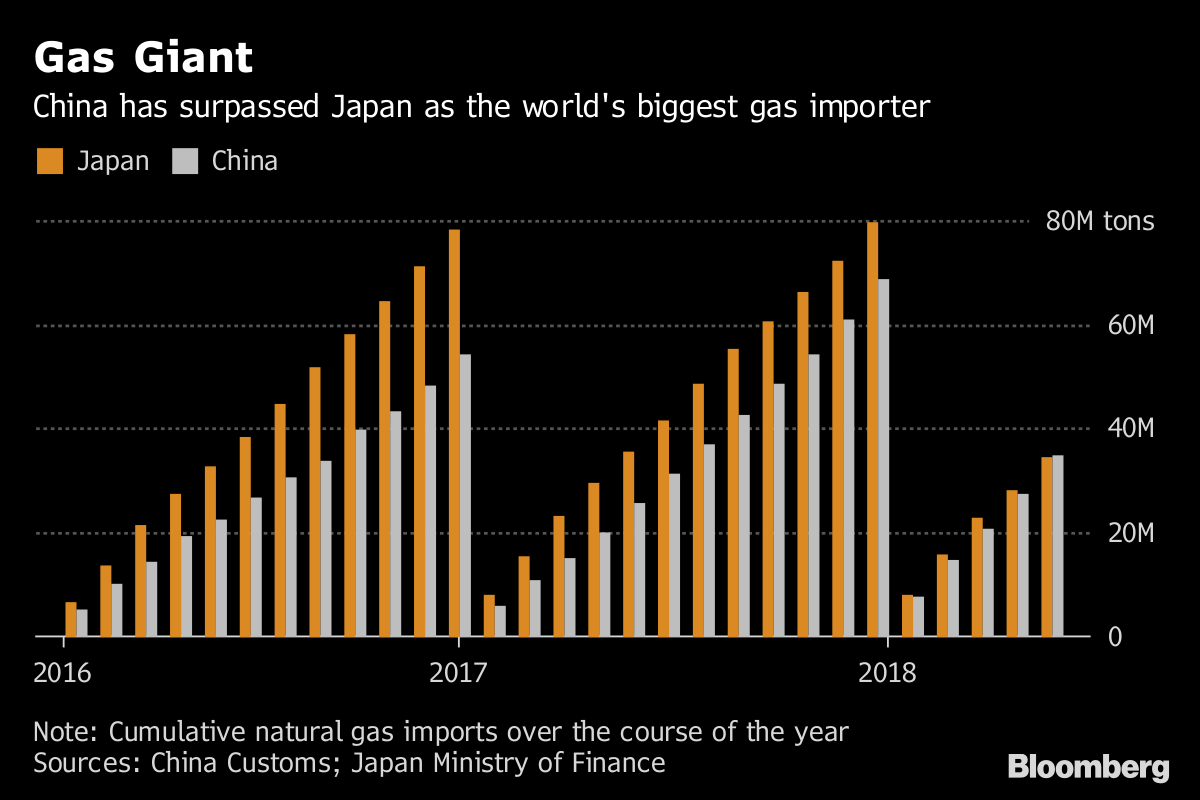
Gas Giant

China has surpassed Japan as the world's biggest gas importer

Sources: China Customs; Japan Ministry of Finance

Note: Cumulative natural gas imports over the course of the year

.chart-js { display: none; }

China imported 7.41 million metric tons of natural gas through pipelines and seaborne tankers in May, according to data released Saturday by the General Administration of Customs. That puts it at 34.9 million tons for the first five months of the year. Japan’s imports during that period total 34.5 million tons, according to its Ministry of Finance. China bought more than Japan in some months last year, but this is the first time its cumulative imports during a year have been higher.

The nation’s soaring natural gas demand has been a boon for the global liquefied natural gas market. China’s on track to become the world’s biggest LNG importer by 2021 as growth in domestic production and pipelines won’t be able to keep pace with needs, analysts at JPMorgan Chase & Co. said in a report June 15.

LNG became the biggest source of China’s overseas gas supply most months over the past year. The nation imported 4.15 million tons of the fuel via tanker last month, compared with 3.27 million tons by pipeline, Saturday’s data show. Piped gas supplies could get a boost late next year when Russia starts up its Power of Siberia pipeline.

China’s first liquefied natural gas terminal opened in 2004 and its first major import pipeline was commissioned in 2009.

Wednesday, June 20, 2018

Soybean prices to trade sideways to down: Angel Commodities


Angel Commodities' report on Soybean


NCDEX Jul Soybean closed lower due to profit booking by the market participants on expectation of good sowing. However,� there expectation good physical demand due to� anticipation of� higher domestic crushing of soybean after government increase� customs duty on crude as well as refine soy oil to 35% and 45%� respectively. Prices have been under pressure on forecast of normal rains and lower meal exports data from both SEA and SOPA is weighing on prices this month.� Soybean acreage till last week is 56 % higher than at 50,000 ha as compared to the last year acreage according to farm ministry report. Bangladesh, one of the largest importers of soymeal from India, reduced the import duty to nil which may result into tough competition for the country from South American peers in soymeal exports to Bangladesh.

Outlook
Soybean futures are expected to trade sideways to down on technical corrections� on expectation of higher sowing due to forecast of normal rains� but� expectation of� improved domestic crushing demand due to hike in import duty for soft oil may� support prices.

For all commodities report, click here


Disclaimer: The views and investment tips expressed by investment experts/broking houses/rating agencies on moneycontrol.com are their own, and not that of the website or its management. Moneycontrol.com advises users to check with certified experts before taking any investment decisions. Read More First Published on Jun 20, 2018 11:56 am

Tuesday, June 19, 2018

Top 5 Penny Stocks To Invest In 2018

tags:SB,FFNW,BDSI,RMCF,CNR,

I have a well-deserved reputation as a cheapskate. I brown bag my lunches most days, keep my thermostat at 79 degrees, and — if my wife doesn’t intervene — I’ll generally wear my clothes until they’re moth-eaten and threadbare. I’m good with that. As Benjamin Franklin said, a penny saved is a penny earned.

Source: Shutterstock

Perhaps not shockingly, I take the same approach in my investing. I like cheap stocks and, specifically, cheap dividend stocks. I like getting paid in cold, hard cash, after all.

Top 5 Penny Stocks To Invest In 2018: Safe Bulkers Inc(SB)

Advisors' Opinion:
  • [By Lisa Levin] Gainers Madrigal Pharmaceuticals, Inc. (NASDAQ: MDGL) shares surged 144.96 percent to close at $265.61 on Thursday in reaction to an encouraging Phase 2 clinical trial update. The clinical-stage biopharmaceutical company said its liver-directed, thyroid hormone receptor called MGL-3196 showed a statistical significance in the primary endpoint of lowering liver fat at 12 weeks and also 36 weeks. Viking Therapeutics, Inc. (NASDAQ: VKTX) shares rose 101.01 percent to close at $9.99 on Thursday after falling 4.42 percent on Wednesday. Akers Biosciences, Inc. (NASDAQ: AKER) jumped 45.58 percent to close at $0.474. The developer of rapid health information technologies said Wednesday afternoon it was granted a 180-day extension from the Nasdaq Stock Market to meet the requirement of a minimum $1.00 per share closing bid price for 10 straight days. Kitov Pharma Ltd (NASDAQ: KTOV) gained 40.93 percent to close at $3.03 after the FDA approved Kitov's Consensi for the treatment of osteoarthritis pain and hypertension. China Customer Relations Centers, Inc. (NASDAQ: CCRC) rose 28.21 percent to close at $19.86. J.Jill, Inc. (NYSE: JILL) climbed 26.45 percent to close at $7.84 after the company posted upbeat quarterly earnings. Curis, Inc. (NASDAQ: CRIS) shares climbed 21.93 percent to close at $2.78 in reaction to an encouraging FDA update. The biotechnology company that focuses on therapies for the treatment of cancer said the FDA granted a Fast Track designation for fimepinostat (CUDC-907) in patients with relapsed or refractory. Boxlight Corporation (NASDAQ: BOXL) gained 21.23 percent to close at $7.48. Kirkland's, Inc. (NASDAQ: KIRK) rose 16.21 percent to close at $12.83 after reporting upbeat Q1 results. The Brink's Company (NYSE: BCO) jumped 16.2 percent to close at $79.25 as the company announced plans to acquire Dunbar Armored for $520 million in cash. Applied Optoelectronics, Inc. (NASDAQ: AAOI) rose 15.14 percent to c
  • [By Lisa Levin]


    Companies Reporting After The Bell SpartanNash Company (NASDAQ: SPTN) is projected to post quarterly earnings at $0.53 per share on revenue of $2.38 billion. HP Inc. (NYSE: HPQ) is expected to post quarterly earnings at $0.48 per share on revenue of $13.57 billion. salesforce.com, inc. (NYSE: CRM) is projected to post quarterly earnings at $0.47 per share on revenue of $2.94 billion. HEICO Corporation (NYSE: HEI) is estimated to post quarterly earnings at $0.53 per share on revenue of $424.96 million. Safe Bulkers, Inc. (NYSE: SB) is expected to post quarterly earnings at $0.02 per share on revenue of $41.10 million
  • [By Lisa Levin]

    Check out these big penny stock gainers and losers

    Losers Big Lots, Inc. (NYSE: BIG) shares fell 9.6 percent to $37.01 in pre-market trading after the company reported weaker-than-expected results for its first quarter and issued downbeat earnings forecast. Tilly's, Inc. (NYSE: TLYS) fell 5.7 percent to $12.98 in pre-market trading after rising 12.69 percent on Thursday. Turkcell Iletisim Hizmetleri A.S. (NYSE: TKC) fell 4.2 percent to $6.39 in pre-market trading after dropping 4.71 percent on Thursday. Sunlands Online Education Group (NYSE: STG) fell 4.2 percent to $9.13 in pre-market trading. Safe Bulkers, Inc. (NYSE: SB) fell 4.2 percent to $3.42 in pre-market trading after climbing 12.62 percent on Thursday. Ulta Beauty, Inc. (NASDAQ: ULTA) fell 4.1 percent to $236.80 in pre-market trading. Ulta Beauty reported upbeat results for its first quarter, but issued weak second-quarter earnings and sales guidance. GameStop Corp. (NYSE: GME) shares fell 3.8 percent to $12.70 in pre-market trading. GameStop reported in-line earnings for its first quarter, while sales missed estimates. Workday, Inc. (NASDAQ: WDAY) fell 3.2 percent to $126.85 in the pre-market trading session after the company posted Q1 results. Lumentum Holdings Inc. (NASDAQ: LITE) shares fell 3 percent to $57.15 in pre-market trading

Top 5 Penny Stocks To Invest In 2018: First Financial Northwest Inc.(FFNW)

Advisors' Opinion:
  • [By Logan Wallace]

    Get a free copy of the Zacks research report on First Financial Northwest (FFNW)

    For more information about research offerings from Zacks Investment Research, visit Zacks.com

  • [By Ethan Ryder]

    Get a free copy of the Zacks research report on First Financial Northwest (FFNW)

    For more information about research offerings from Zacks Investment Research, visit Zacks.com

Top 5 Penny Stocks To Invest In 2018: BioDelivery Sciences International Inc.(BDSI)

Advisors' Opinion:
  • [By Logan Wallace]

    BioDelivery Sciences International (NASDAQ:BDSI) had its target price reduced by research analysts at HC Wainwright from $4.00 to $3.50 in a research report issued to clients and investors on Wednesday. The brokerage currently has a “buy” rating on the specialty pharmaceutical company’s stock. HC Wainwright’s price objective points to a potential upside of 40.00% from the company’s current price.

  • [By Lisa Levin] Gainers Comstock Holding Companies, Inc. (NASDAQ: CHCI) shares climbed 154.95 percent to close at $5.15 on Thursday. Comstock reported conversion of the majority of its unsecured, short-term debt into non-convertible preferred equity. Tyme Technologies, Inc. (NASDAQ: TYME) jumped 33.45 percent to close at $3.87. Universal Corporation (NYSE: UVV) gained 29.72 percent to close at $62.85 after reporting fiscal Q4 results. Evolus, Inc. (NASDAQ: EOLS) shares rose 22.93 percent to close at $23.80. nLIGHT, Inc. (NASDAQ: LASR) jumped 21.52 percent to close at $36.37 following Q1 results. Hudson Technologies Inc. (NASDAQ: HDSN) gained 20.28 percent to close at $2.61. The Cato Corporation (NYSE: CATO) shares rose 19.57 percent to close at $21.45 after the company posted better-than-expected first-quarter results. AXT, Inc. (NASDAQ: AXTI) gained 18.8 percent to close at $7.90. Catasys, Inc. (NASDAQ: CATS) rose 16.33 percent to close at $6.41. HUYA Inc. (NYSE: HUYA) rose 15.68 percent to close at $23.09 on Thursday. Marinus Pharmaceuticals, Inc. (NASDAQ: MRNS) climbed 15.11 percent to close at $6.02 on Thursday after gaining 6.30 percent on Wednesday. Baird initiated coverage on Marinus Pharmaceuticals with an Outperform rating. Destination Maternity Corporation (NASDAQ: DEST) shares rose 14.48 percent to close at $3.32 after the board announced late Wednesday the election of four activist-backed director nominees. Three women and one man comprise the selected group championed by NGM Capital’s Nathan Miller and Kenosis Capital’s Peter O’Malley. Destination Maternity had advocated for another slate of three men and interim CEO Melissa Payner-Gregor. The new directors are Holly Alden, Marla Ryan, Anne-Charlotte Windal and Christopher Morgan. China Rapid Finance Limited (NYSE: XRF) gained 11.53 percent to close at $3.29 after announcing preliminary Q1 results. Bilibili Inc.. (NASDAQ: BILI) shares rose 11.33 pe
  • [By Lisa Levin]

    BioDelivery Sciences International, Inc. (NASDAQ: BDSI) shares were also up, gaining 19 percent to $2.3272 after the company announced board restructuring plan and $50m equity financing deal led by Broadfin to "significantly strengthen" financial position.

Top 5 Penny Stocks To Invest In 2018: Rocky Mountain Chocolate Factory Inc.(RMCF)

Advisors' Opinion:
  • [By Ethan Ryder]

    Rocky Mountain Chocolate Factory (NASDAQ: RMCF) and Tootsie Roll Industries (NYSE:TR) are both small-cap retail/wholesale companies, but which is the better stock? We will contrast the two companies based on the strength of their valuation, risk, earnings, institutional ownership, profitability, dividends and analyst recommendations.

  • [By Max Byerly]

    Rocky Mountain Chocolate Factory (NASDAQ: RMCF) and Tootsie Roll Industries (NYSE:TR) are both small-cap retail/wholesale companies, but which is the better investment? We will compare the two companies based on the strength of their risk, valuation, dividends, analyst recommendations, earnings, profitability and institutional ownership.

Top 5 Penny Stocks To Invest In 2018: China Metro-Rural Holdings Limited(CNR)

Advisors' Opinion:
  • [By Stephan Byrd]

    Brokerages expect Canadian National Railway (NYSE:CNI) (TSE:CNR) to announce earnings of $1.03 per share for the current fiscal quarter, Zacks Investment Research reports. Eight analysts have issued estimates for Canadian National Railway’s earnings, with the highest EPS estimate coming in at $1.10 and the lowest estimate coming in at $0.97. Canadian National Railway reported earnings of $1.00 per share in the same quarter last year, which would indicate a positive year over year growth rate of 3%. The business is scheduled to issue its next quarterly earnings report on Tuesday, July 24th.

  • [By Max Byerly]

    Canadian National Railway (NYSE:CNI) (TSE:CNR) – Cormark raised their Q3 2018 earnings per share (EPS) estimates for Canadian National Railway in a research report issued to clients and investors on Tuesday, April 10th. Cormark analyst D. Tyerman now expects that the transportation company will post earnings per share of $1.15 for the quarter, up from their previous estimate of $1.14.

  • [By Shane Hupp]

    Her Majesty the Queen in Right of the Province of Alberta as represented by Alberta Investment Management Corp cut its position in Canadian National Railway (NYSE:CNI) (TSE:CNR) by 21.1% during the first quarter, according to the company in its most recent disclosure with the Securities & Exchange Commission. The institutional investor owned 1,956,400 shares of the transportation company’s stock after selling 522,300 shares during the period. Canadian National Railway accounts for about 1.7% of Her Majesty the Queen in Right of the Province of Alberta as represented by Alberta Investment Management Corp’s investment portfolio, making the stock its 7th biggest position. Her Majesty the Queen in Right of the Province of Alberta as represented by Alberta Investment Management Corp owned 0.27% of Canadian National Railway worth $184,215,000 at the end of the most recent reporting period.

  • [By Shane Hupp]

    Wall Street analysts expect that Canadian National Railway (NYSE:CNI) (TSE:CNR) will announce $1.02 earnings per share (EPS) for the current quarter, according to Zacks Investment Research. Seven analysts have provided estimates for Canadian National Railway’s earnings, with the highest EPS estimate coming in at $1.06 and the lowest estimate coming in at $0.97. Canadian National Railway reported earnings per share of $1.00 in the same quarter last year, which would suggest a positive year over year growth rate of 2%. The company is expected to announce its next quarterly earnings results on Tuesday, July 24th.

Friday, June 1, 2018

Motley Fool Answers' May Mailbag: More Advice for Making the Most of Your Money

If it's the last week of the month,�odds are that Alison Southwick and Robert Brokamp�are going to amble over to the Motley Fool Answers mailbag to find out what their listeners really want to know. And for added gravitas and expertise, they've brought in reinforcements:�Naima Barnes, a financial planner with Motley Fool Wealth Management, a sister company of The Motley Fool. Among the topics on deck are retirement accounts, HSAs, long-term care insurance, market timing, and car buying.

A full transcript follows the video.

This video was recorded on May 29, 2018.

Alison Southwick: This is Motley Fool Answers. I'm Alison Southwick and I'm joined, as always, by Robert Brokamp, personal finance expert here at The Motley Fool.

Robert Brokamp: Hi, Alison!

Southwick: It's the May mailbag, and this month we're joined by Naima Barnes. She's a financial planner with Motley Fool Wealth Management, a sister company of The Motley Fool. Hi, Naima!

Naima Barnes: Hello!

Southwick: Today we're going to tackle questions about HSAs, long-term care healthcare insurance, and car buying. All that and so much more on this week's episode of Motley Fool Answers.

__

Southwick: Let's get into it. Our first question comes from the Twitters. The question is, "If the conversion of funds from a traditional IRA to a Roth IRA is counted as income and taxed, then what is the benefit of doing this?"

Brokamp: So, whenever you convert money that's in a traditional account to a Roth, that amount gets added to your taxable income. If you convert $10,000 you have to add that $10,000 to your income, so you're going to pay more taxes this year. The benefit is that ideally you are in a lower tax bracket this year and you'll be in a higher tax bracket in retirement. Basically, you're paying taxes today, or prepaying them, really, at a low rate so that you can get a better benefit when you retire.

There are all kinds of calculators on the internet that will help you analyze the situation. I found one at calcxml.com. Just very quickly a little hypothetical, here. Let's say you're 35 and you're in the 12% tax bracket today. You convert that $10,000 to a Roth. Let's say you're in the 22% tax bracket in retirement. What's the difference? Well, if you do the conversion, that account will provide $8,700 a year in retirement. If you don't do the conversion on an after-tax basis, the traditional IRA will just provide $7,500 a year. You're getting more than $1,200 a year in after-tax income by doing the conversion.

Obviously, this takes some assumptions. You don't really know what the future's going to look like, so there are other reasons to do a conversion. One is a traditional IRA or 401(k), you have to take out required minimum distributions at age 70 and a half. The Roth IRA, you do not, so that's another benefit. You can let that money grow a little longer.

Also, it gives you what's called tax diversification. When you're in retirement, if you have a year in which you have high taxes for any reason [maybe you got a lump sum investment of some kind, a big capital gain], you can tap the Roth, then, to counteract being driven up even higher into a higher tax bracket.

One word of caution, though, is let's say you're in a low tax bracket today and you decide that the conversion makes sense. When you do the conversion, that money gets added to your taxable income which could drive you up into a higher tax bracket, so you only want to convert so much so that you stay in the current tax bracket and not get driven up into the next one.

Southwick: Our next question comes to us from Leisha. "I'm in need of a car, soon. I am self-employed, though the vehicle will be used for personal use, not business. I'll need to take out a loan, and I see three options. One, apply by myself. Self-employed with a low net income [$22,000] but with a good FICO score of 760. Two, husband applies by himself with higher income [$79,000] but some late payments and a much lower FICO score of 690. Three, we apply jointly to show his income, too, and both of our FICOs. What kind of documentation would be needed to document my income? Is there any chance that a bank would be impressed with my FICO store and not want to see 1040s? Do we have a better shot applying for financing with a car dealership's financing or my local bank? Thanks so much."

Barnes: First of all, taking a look at credit scores will play a factor when choosing a car. There are a bunch of calculators out there on like Bankrate and NerdWallet that you can use to see what you would qualify for.

And in terms of whether you should apply as a single or a joint owner, usually when you apply for a joint car loan it's when you don't think that you're going to qualify for a loan on your own. You want to steer away from that, because his score is lower. In that case, I would say apply by yourself, but go in pre-qualified.

You can go onto one of those calculators. They'll give you different rates of loans in your area and then you can pre-qualify for it and take that to the dealer and say, "I pre-qualified for this amount. Will this work?" They'll also ask for a proof of income, whether that be with your tax return or 1099. If you are filing jointly, then it will show that you guys have enough income to support the needs for the car.

Brokamp: And generally speaking, the dealership is not going to give you the best rate. Obviously, that varies from dealer to dealer, but generally speaking you're going to get a better deal from a bank. And to answer one of her questions [is it possible to even get the loan based on the FICO], I was able to do that through a service called LightStream, which comes through SunTrust Banks. All they wanted to see was our credit score. We did not have to provide any other information. It was very easy to get the loan, and it was easy to pay it off, because we paid it off sooner, so that option does exist.

Barnes: When I applied for my car loan, I went online and looked at Capital One�and Ally. They didn't ask for anything but my credit score, either.

Southwick: The next question comes from Stormy. "My mother is 73 and retired. Her house is paid for and she has money coming from Social Security, an annuity, and an IRA. She has enough money for regular, day-to-day stuff plus a little extra. She also has about $100,000 sitting in a bank account earning 0.4% interest, which is nothing. This money is a buffer if an unexpected expense comes up. I want her to get this money into an account that would keep up with inflation; otherwise, she's losing money every year. She's onboard with that.

This is money that should be liquid and not volatile. I don't want to invest in stocks. Bonds are an option, but I'm not finding a bond fund that would keep up with inflation. The bank wants to put her into an annuity. I'm not excited about that either. She's OK with a 12-month CD, but I'm not seeing good rates either. Do you have any suggestions?"

Brokamp: First of all, interest rates have risen significantly over the last year, so there is absolutely no reason to be just earning 0.4% at a bank. If you go to the Motley Fool Banking Center, you'll see that there are savings accounts that are yielding 1.7%. One-year CDs 2.4-2.5%. There's just no reason to be sitting there in that type of a situation.

I do agree with you that stocks are not a good place for this money. I also agree with you that bond funds are not the best place, either, because bond funds can go down in value. In fact, the total bond market index from Vanguard is down about 2.5% this year because interest rates have gone up, so cash is definitely the place to be.

You will find better rates through online banks, which does make some people uncomfortable, but if that makes your mother uncomfortable, maybe with that $100,000 keep $25,000 at the local bank but do the rest with an online bank.

In a previous mailbag we also talked about iBonds, since you brought up something that keeps up with inflation. It's a mix. iBonds are offered through the U.S. government, so they're very safe. They have a fixed rate plus a rate that varies according to inflation. The current rate on iBonds is 2.5%, so it's pretty good. They're not as liquid, though. You can't touch them within 12 months, and if you take them within five years, you lose three months' worth of interest, but for a portion of your money that's probably a good place, too.

Southwick: The next question comes from Brian. "I have a high deductible insurance plan with a health savings account. If I move to a new company that has another plan type, what should I do with the money remaining in the HSA?" This might apply to me, as well. I might have some money sitting somewhere now that I think about it. So, Brian and Alison want to know what you do with it.

Barnes: HSAs are amazing. They're one of the best investment vehicles, especially because you can use them for health expenses. But when you leave a company and you still have money in your HSA, you can take that with you, and because HSAs are an investment vehicle, you can invest them once they reach the threshold.

But in order to continue to contribute to it, you do need to make sure that the current employer that you're at, or if you're applying for health insurance on your own, is a high deductible health plan or HDHP. If it's not one of those plans, then you're unable to continue to contribute to your HSA.

Brokamp: And like any other investment account, you do want to pay attention to fees and investment choices. If your current provider of the HSA isn't very good, you can transfer it.

Barnes: A cool thing with them is that you can use them for long-term care. If you keep it in there and then you need it when you're retired, you can use that for long-term care expenses.

Brokamp: Right. One of the big benefits is as you get to a certain age in retirement -- once you reach that age and if you still have money in the account -- you can use it for anything you want. While you're working, you have to use it for medical expenses. Once you retire, you can use it for anything.

Southwick: That's fun.

Brokamp: Yeah.

Southwick: I've got to go figure out if I really do have an HSA hanging out somewhere. The next question comes from Mark. "I am 39, married, and have two kids. I will be getting a pension, but because I was only at that employer for seven years, it will be small; just $400 a month at age 65. Recently they offered to buy my pension out for a lump sum of $15,000. I can't recall if it would be taxed as ordinary income or if the $15,000 was an after-tax amount.

I was debating taking the money and investing it myself. With the assumptions of the market returning 8-10% annually, retiring at 65 and living another 20 years beyond that, the amount would end up being more than the $400 pension. On the other hand, it is reassuring to think that I would have a steady source of monthly income even if it is only $400. What would you do?

Also, as a side question, if I were to die prior to retiring and getting the pension, would my wife get the $400 a month?"

Brokamp: Well, Mark, you took the right step to begin with, in that you ran some numbers. And I did some back-of-the-envelope math and saw that you're probably right. If you do earn at least 8%, you're probably better off taking the money. Of course, that's not a guarantee, but that's the first step, and you're right. You probably will have more money if you take the lump sum of that for yourself.

If you take the lump sum you should move it to an IRA or your current employer's 401(k), otherwise it will be taxed. You don't just want to take that money as a check and put it in your checking account. You want to move it to another tax-advantaged account.

The other thing, too, is if you like the idea of some sort of guaranteed income when you retire, you can take the lump sum, invest it, and then when you turn 65, use the money to buy an annuity if that's what you want. I recently read a study from Towers Watson that found that as retirees have some sort of annuitized income [it could be a pension, it could be an annuity, it could be higher Social Security benefits], the happier they are. They feel more at peace. They feel more satisfied, so there actually is a psychological benefit to having that check coming in each and every month.

As for what will happen to the benefit for your spouse if you die before you take it, you need to check with the pension provider, but that's a very smart thing to do, and when it comes to any retirement planning decision, you should always think about how it's going to affect you, but also your survivors. What happens if you die? Will the benefits still continue?

Southwick: Our next question comes from Rob from Crozet, Virginia. "I have two questions about 529 accounts. Say, theoretically, a family lives in the great Commonwealth of Virginia, where we can deduct from state income up to $4,000 per account. This theoretical family is considering moving out-of-state -- commonwealth --" [people get real nitpicky about that], "and was wondering what they should do if anything with those accounts.

To complicate it slightly, let's say they have Virginia accounts for their adult daughter who lives far away, really for her future children; their high school senior son, who will withdraw some money next year; and their grade school niece and nephew who currently live in Virginia."

Brokamp: These people are very generous in terms of looking after the college well-being of many relatives.

Southwick: Yes, that's awesome!

Barnes: So, when you move out-of-state, theoretically...

Southwick: Theoretically...

Barnes: ... you can keep your 529 at your current state plan, so you can keep it in your Virginia plan if you enjoy the investment options that you have with that plan. There's two benefits to moving it out of the Virginia plan. If you move to a state that also has a deduction; yes, that's one of the biggest benefits. You can move it to that plan and that plan will provide you with the tax deductions that you're looking for.

And then the other benefit would be to move it to a plan that has better investment options. On some of the list of the best 529 plans, Utah is a really good one. New York. Maryland. Those are all really great plans. If you move to a state and they might not offer the tax deduction, or the investment options are terrible, then you can move it to any other state that has a great investment option or is one of the more reputable 529s.

Brokamp: Right. And Morningstar rates plans. SavingForCollege.com rates plans. You can go there to see what the ratings are on your various options. But you can have multiple 529s in multiple states, so that's perfectly fine. You don't have to use your state's plan.

A couple of things I would highlight, here. I found this out from Tim McFillin, who is with TheCollegeFundingCoach.org and was on the show last month. For Virginia, for example, the limit for the deduction is $4,000. If you contribute more than that you have two options. The money you contributed over that amount you can deduct in a future year or just open a separate account, because it is per account. So, if you're going to contribute $8,000 just contribute to two separate accounts. Even for the same kid you can take the deduction in the same year.

And the other thing I'd point out about the 529 for the nieces is when it comes to accounts that are owned by relatives other than parents, the distributions from those plans can affect financial aid, so generally you want to save those for the last year of college.

Southwick: With Virginia, if you are going instate or if you are using a 529 within Virginia, doesn't it go farther if your kids choose a Virginia school?

Barnes: No.

Brokamp: Well, that's a good point. There are really two 529 plans. There's the savings plan, which is basically like a 401(k). You choose from among the mutual funds. In that case, no. If you are choosing the prepaid tuition plan, you can only get that guarantee if you choose a Virginia state school. You can go out-of-state, and you get most of that money back, but it's not guaranteed to cover tuition at that school.

Southwick: You've really got to look closely at the fine print of these plans.

Brokamp: Right. I will point out, by the way, that this show is airing on May 29th -- 529.

Barnes: Ooh!

Brokamp: Hey.

Barnes: And you can use your 529, now, for K-12.

Brokamp: That's right. After $10,000 you can use it for private elementary and secondary school costs.

Southwick: And Ron has a follow-up question. "Is there a time limit for the funds to be invested? If we find that we need non-529 money to pay tuition, could we fund a money market type of 529 account up to the maximum deduction, then take the money out a couple of months later to pay tuition? When I fill out my state taxes, it doesn't say anything other than how much we contributed. I guess really one could put in well more than the limit and carry over the extra to deduct on future tax returns. Getting back 5.75% of that money in Virginia seems like cheating. Yours, theoretically, Rob."

Barnes: You can. Definitely if the investment options offer a money market vehicle for investing you can put it in there. There isn't a time limit that you have to keep the money in a 529, so you can do that theoretically, and you still get the deduction because it will show as you put in money for the 529 for that year. But the contributions for a 529 are immediately invested, so you do want to make sure that those contributions are going toward a money market or bond-type fund when you invest them.

Brokamp: Right, because you're really spending the money within the next year or so, so you're playing pretty safe with it. There is something called "tax recapture" with 529s, by the way. If you put money in and get the state deduction, and then you end up using the money for something other than qualified higher education expenses, you might have to pay back some of that money that you got through the deduction. That varies by state, but just understand that if you end up using the money for something other than college, you may have to give some money back.

Southwick: The next question comes from Pete in Phoenix. "I've got a question about alternatives to long-term care insurance. I know there's a range of options out there, but the premiums can be relatively high, especially if you factor in an inflation adjustment and do away with the five-year limitation on benefits. I know you need insurance for the unexpected, but I hate the idea of paying hundreds of dollars a month well into retirement.

Would it be better just to sock that premium money away in an IRA after maxing out my employer's 401(k)? Assuming I have my home paid off in retirement and a decent payout from my other investments, would it make sense to use this 'long-term care' IRA as an old-age emergency fund and as an alternative to long-term care insurance?"

Brokamp: Long-term care insurance is a tough one. Let's start with whether you're going to need long-term care. If you go to [LongTermCare.acl.gov], they have some good stats. The stats are that you'll need some type of long-term care, probably. It also shows that the majority of that long-term care is in-home care, so you'll need help with some kind of shopping, cleaning, bathing, and stuff like that.

Roughly speaking, anywhere from one-quarter to one-third of people will need some sort of facility care, so you're talking about a nursing home, and that's where people get very concerned, because on average [it varies where you live], a nursing home costs $8,000 a month. A large amount of money. So, it's in those situations where people get scared. On average, people stay in a nursing home about a year, but a good percentage of them [around 20%] stay for more than three years and the chances that you'll go into a nursing home and stay there longer increase if you're a woman because you'll be living longer. That's a factor to consider.

Given those odds, a lot of people think, "Well, of course, long-term care insurance would make sense." The problem is, first of all they are expenses, so if you're in your fifties or maybe early sixties, it's going to cost you $3,000 to $3,500 a year. Now, what you'll be told is that that's all you have to pay.

Unfortunately, the history of long-term care insurance over the last 10 to 15 years is that many companies underpriced their policies and had to come back to policy owners and say, "Actually, you have to pay more. Either you have to pay more, or we have to reduce your benefit," and this happened just recently. One of the last holdouts was MassMutual in terms of raising premiums on people, but now they need to raise premiums about 77% on 54,000 policies.

Because of these problems, people are getting out of this industry. At its peak in the early 2000s, there were more than 100 insurance companies offering long-term care insurance. Now, there are about 12, because they underestimated how much it was going to cost to pay these out. They underestimated how long people would keep these policies. Insurance companies always factor in the odds that people just won't pay their premiums anymore. And low interest rates, which can be devastating to insurance companies because they invest most of their savings, or the premium money, in bonds and things like that.

So, should you get long-term care insurance? Generally speaking, I like your idea, actually, of being able to self-insure. Save enough money. I love the idea of you calling it -- what did you call it? -- your long-term care IRA. There is no such thing, of course, but just mentally you're thinking this is the money I may need for long-term care. Also, with the house paid off, you can use home equity to pay for a lot of long-term care, especially in-home long-term care. You can get a reverse mortgage, pay for someone to come in and do some of the services you need.

Now, if you get a reverse mortgage and then have to go to a nursing home, then you have to pay back the reverse mortgage, but it's still, I think, one way to think about home equity in retirement as that big, fat emergency fund that could cover long-term care and expenses if you need it.

Southwick: There's no easy answer for long-term care insurance.

Brokamp: There really isn't, and when you think of life insurance, when you get a life insurance policy, it's pretty efficiently priced. If they tell you it's going to cost you $500 a year, you can be pretty sure that's what it's going to cost you. You don't have to worry about any sort of future increases. But long-term care -- the history is that's just not been the case.

Southwick: The next question comes from Ravine. "Over the past year, I have slowly begun investing through the app Robinhood using some advice from Stock Advisor. I recently came across IRAs and have a question. As a 21-year-old, is it smarter to max out a Roth IRA and then invest? My primary concern is when pulling money out close to retirement, the tax rates are relatively the same and I'll lose 40% in taxes, whereas with the Roth IRA, I get to keep all the money. I know it's a far way out and a lot could change. Any advice would be greatly appreciated." Well, good for you! A 21-year old? Oh, you are on it.

Brokamp: Very impressive.

Barnes: That's great. I would say that as a 21-year-old, it is great to max out your Roth IRA because you'll be able to enjoy the benefits of that potentially tax-free in retirement. And you can use Stock Advisor to pick the stocks that you're holding inside of your Roth IRA.

Robinhood is great. I use it for just playing around with a few dollars here and there, but it's not where I keep my retirement fund. So, thinking about retirement, I have a Roth IRA that I use for 70 and a half, since that will be when necessarily I'll probably be pulling that money out, but that's not where I keep my retirement fund. So, using Robinhood for just maybe short-term expenses that you might have [meaning like three to five years] and nothing that you'll need today. Or if you're saving up for a house or a trip, that's good for that, but in terms of retirement expenses, I say go Roth IRA and max it out if you can for as long as you can.

Southwick: So, for our listeners who aren't familiar with Robinhood, it's like an online brokerage, but they don't charge you any trading fees. Robinhood is doing very well as a company, right now and it's very attractive. Maybe for our listeners who aren't familiar with it, can you talk a little bit about why someone might use Robinhood?

Barnes: Sure! How Robinhood started was they wanted to be able to allow people to trade stocks without charging any commission fees. Some brokerage companies have fees that are $4, $7. It varies depending on which company you're going with. Robinhood wanted to get away from that, and they started only on mobile phones. They have an app that you can download in the App Store, and you set up your account that way. They have since branched out to providing different types of things you can invest in. You can now invest in ETFs, which might not have been there when they first got on there, as well as bitcoin.

Brokamp: How do you feel about bitcoin, Naima?

Barnes: No, thanks. So, they've gotten to a place where they can offer different types of ways that people can invest and it's pretty cool. You can set it up that it links to your bank. It can do recurring withdrawals to your Robinhood account so that you have a certain amount that's getting put into your account on a regular basis. And the regular Robinhood account is free.

They do have a Robinhood Gold account. I don't know much about that. I think you have to pay for it, but regular Robinhood is free, so it's pretty cool if you want to just look on your phone and do some trading.

Brokamp: And the trick, here, is that Robinhood does not offer IRAs.

Southwick: Right.

Brokamp: That's the thing, so it cannot be a retirement account. And I'll just say for Ravine again, awesome for you thinking about saving for retirement at your age. Just know that the amount you can contribute to an IRA of any kind -- you have to have earned income first. If you have a part-time job and you only make $2,000, that's the most you can put in the IRA and you can't max out to the $5,500.

Barnes: You do want to make sure that first you have earned income, second you have enough for emergencies...

Brokamp: Right.

Barnes: ... third, max out that IRA with the limit. So, if you work full-time and you make $5,500, go ahead and do it.

Brokamp: Yes.

Southwick: The next question comes from David. "Following a suggestion I heard on this show, every last day of the month I put together a financial summary for my family that includes things like income, assets, expenditures, savings, and investments. I also give us a grade. What things did we do well this month? Which things not so well? I print it out and we talk it through as a family." So cool!

Brokamp: Yes, that's pretty impressive.

Barnes: I love it.

Southwick: "One of the more challenging elements of the numbers is our savings rate. I wanted to track this on a monthly basis because I was of the opinion that we started late to savings. We're an average of 40 years old and have saved around 3x our income in my 401(k). We also have a one-year-old son and wanted to make sure we were saving enough for his education. Our aim has been to maintain at least a 40% savings rate every month.

How should this be calculated? My working formula currently takes the amount we save or invest, adds what my employer contributes to my 401(k) plan, then divides by our after-tax income. Is it right to include the employer contribution? Am I right to use the after-tax income number? I also split the mortgage payment into the interest and principal. The interest is classified as expenditure and the principal is classified as savings because it pays down a debt and increases our net worth. Similarly, our auto loan principal repayment is classified as savings as are our HSA contributions.

In a nutshell, my question is how we ensure that the 40% we think we're saving is the same 40% you think we should be saving in our situation?"

Brokamp: First of all, I would say you're actually not behind on your savings. There are various analyses that look at how much you should have saved at various ages. We've talked about them in previous episodes as a multiple on your income.

Recently MarketWatch tweeted out that the average 35-year-old should have twice their income, and there was a lot of jokes and scorn made about that. But to the extent that you believe in this study, Fidelity thinks you should have 3x your income by age 40, so you're actually on that target. T. Rowe Price's analysis is you should only have twice your income at age 40, so you're actually doing fine.

That said, how to calculate your savings rate. I would say you include any asset that you are willing to spend for that specific goal. I wouldn't necessarily calculate an overall savings rate, although I think that's still interesting, but I would do it based on each goal.

For example, for retirement include what you've contributed to the 401(k) as well as your employer match and do it as a percentage of gross income. That's how most of these are calculated, so doing an after-tax income is actually making your savings rate look a little higher. I would do it as gross income.

I would not include the car payment in your savings rate, because that's basically a loan to buy a depreciating asset. Unless you are investing in some sort of antique car that you plan to sell in retirement or as a retirement asset, I wouldn't include it.

The mortgage and HSA are a little different. They're a little trickier. We talked about HSAs. Chances are you're not going to spend most of that money, and it will be a retirement asset. How much will be in that, though? How much you'll need I don't know, so I think it's safer to not include it.

Mortgage is also a little trickier because generally speaking, when you look at your retirement, you look at just what's in your portfolio [your IRAs, 401(k)s and other things like that]. Although as we talked about on a previous episode, more and more financial planners are saying you should be incorporating your home equity.

I think this is an evolving view. I still tend to side with the folks who say that really you should look at your home equity as a big, fat emergency fund and not plan on spending it. In that case, then, I would not include the mortgage in my savings rate. I think it's quite possible, as I think about this more as the years go on and appreciate the fact that really people have more in their home equity than they have in their 401(k)s. Then I might change my opinion on that a little bit.

Southwick: But for now...

Brokamp: But for now, I would just factor in that. And for the savings rate for your son's college education I would just calculate how much you're putting into the 529.

Southwick: And our final question comes from Josh. "I'm a 29-year-old teacher from Florida and would like to start investing. I pay into a pension fund for work but have saved another $10,000 and I'm unsure where best to allocate it. I'm most interested in putting the money in the stock market and I've had success so far; however, I recognize that I'm pretty late to the party." Oh, Josh! You are not late to the party!

"And I am worried about the dreaded correction that is coming. I'm not really interested in starting an IRA. Should I just pull my money out and wait for the correction, or put my money somewhere else?" All right, Naima.

Barnes: Well, Josh...

Brokamp: First of all, we love Josh for two reasons. He's a teacher...

Barnes: He's a teacher.

Southwick: From Florida!

Brokamp: From Florida! I am also.

Southwick: You're a teacher from Florida.

Brokamp: This is the truth, yes. All right, go ahead, Naima.

Barnes: That's awesome. So, first things first. I would make sure that you have an emergency savings, because I'm all for it. You need to make sure that you can cover an unexpected car expense. An unexpected flight to go see family. If you've already got that covered, great. It's also great that you're paying into your employer's pension plan because that will be a stream of income when you're in retirement.

In terms of the $10,000, seeing that you've hypothetically already covered your emergency expenses, just go ahead and invest it. There's no time like the present. If right now you're not making anything really [you might be making that 0.04% on your bank account], why not try and make a few extra dollars on it? Put it inside of a taxable account, since you don't want to use an IRA, and get into the market.

Southwick: He could also dollar-cost average into it, right? Like if he's worried that there's a correction around the corner... And by the way, people have been saying that there's a correction around the corner for the last 10 years.

Brokamp: Including us.

Southwick: Including us.

Brokamp: Including me, I should say.

Southwick: Yes, you're a little, dark rain cloud over that. So, he could also dollar-cost average in. Just go in a few thousand every few months.

Barnes: Yes, he can definitely do that. Dollar-cost averaging can also be tricky because say, for example, one of your stocks starts at 10 bucks, and then it goes to 15 bucks, you've already made five bucks and you're waiting for it to go down a bit, then you're still doing a little bit of market timing. That's the only concern with dollar-cost averaging, but if you're just purely moving it from cash and then just investing it however you invest it, then that's fine, too.

Brokamp: I recently did a little bit of research on how stock market valuation affects the safe withdrawal rate in retirement. There have been many studies about this going back four, five, six years. And every single one of those articles said, "Well, people should be nervous, now, because the stock market is so expensive and who knows what's right around the corner."

But, of course, the market has done pretty much nothing but go up since then. This year has been a little dicier. And these articles are written by some of the smartest people in financial planning.

The bottom line is no one really knows when the correction is coming. Josh, you're young. Assuming that this money is for retirement, you've got decades for this to recover from any correction that happens. Chances are you're just better off investing it now.

Southwick: Right. We want you to hold these investments for three, five, 10 and even more years. There will be plenty of time for you to go through a horrible, painful period but then come out on the other end happy.

Barnes: Time is on your side.

Southwick: Absolutely, and we know what bumper music Rick is going to use.

Rick Engdahl: Can you just sing it for me, Alison?

Southwick: Oh, I could. I could.

Brokamp: Theoretically.

Southwick: Theoretically.

__

Southwick: That's all for the questions -- sort of. We have some listener feedback to get to. Matt heard our episode with Scott Kennedy [from the Center for Strategic and International Studies] about the trade war. In the episode, Scott mentioned that we, here, in the U.S. are using cheap solar and not the best solar technology, so Matt wants to know what the best solar is.

I emailed Scott, and he wrote back and said, "A big expert on solar with whom I've consulted is Varun Sivaram, a scholar at the Council on Foreign Relations. These ideas are in his new book, Taming the Sun: Innovations to Harness Solar Energy and Power the Planet." There you go, Matt. Go read that book.

Matt also had a bone to pick with Bro.

Brokamp: Uh-oh. What did I do?

Southwick: Bro suggested for a backdoor Roth to wait six months plus or minus before the conversion to avoid taxes. Matt doesn't like this strategy because you don't want any earnings in your traditional IRA before the conversion, so "I convert right away, usually within three days due to transaction time. It is called a loophole, but it is perfectly legal. If the government doesn't want me to do it, they are welcome to change the law and I will abide by the tax laws."

Brokamp: There's a little bit of controversy about this, so the idea of putting money into the non-deductible, traditional IRA and pretty soon, thereafter, converting looks like a loophole, so you will see very heated arguments online by people saying no, you need to wait a little bit.

On the other hand, there are people who say no, that's fine and one of them is Ed Slott, who's considered one of the premier IRA experts here in the country and has a very thorough article about why it's actually OK to convert pretty soon. So, it's debatable. Chances are he's probably right, but it just depends on how much chance you want to take with messing with the IRS. You're probably fine.

Southwick: I guess if you have a podcast that's listened to by a dozen listeners, or so, you want to maybe play it safe, huh, Bro?

Brokamp: Yes, that's true. If there's anything about me, it's about playing it safe.

Southwick: Mark heard last week's episode about how to evaluate your 401(k), and he had a follow-up question about BrightScope Ratings. "I work for a company that utilizes ADP for payroll benefits and retirement planning. In turn, ADP uses Voya for their 401(k) plan. Should I be evaluating Voya funds, then?" I think you need to clarify what you get out of BrightScope.

Brokamp: BrightScope just takes the data that's filed with the Department of Labor -- it's called the Form 5500 for each plan -- and pulls the data straight from that. Whatever is in your plan, that's what's being evaluated by BrightScope.

Southwick: But he should go to BrightScope and look for his employer, right? He searches for his employer and not for Voya funds.

Brokamp: Yes, he needs to look at his employer. And it can be tricky because some employers [especially really big multinational corporations] have different units that will have different 401(k) plans. You've got to make sure that you are choosing the right unit for which you work.

Southwick: Josh on Twitter heard your advice about going to BrightScope and he looked up his employer, which is Microsoft's�401(k), and it was awesome. So, hooray, Microsoft! They got an 88.

Brokamp: Wow! That's pretty impressive.

Southwick: So, people are actually following your advice. Also, over on Twitter is [OldSchoolMike] who listened to the episode about evaluating your 401(k). He took a gander at his 401(k) allocations and then swapped out an actively managed international equity fund with a 0.08309% fee for a passive one. In his defense, the passive option was added last year without him looking or caring. So, they snuck that one in. Also, you guys keep posting reviews on iTunes and they're so kind!

Brokamp: They really are. I showed them to my wife last night. It's just so nice.

Southwick: It's so... Oh! Like I don't even have words to explain how heartwarming it is to hear you guys. I want to thank Brendan, and MrCornyGuy, Luke, Linda. The problem with these names is they're not really names, sometimes. [Revealo], KRBMeister.

I love all of the posts equally, but I have to call out Linda, who wrote, "Since listening a few years ago, among using other tools, I've paid off all credit card debt, stashed away a six-month emergency fund, have contributed significantly to my 401(k), HSA, started investing in stocks, and have a goal of saving 30% of our annual income."

Brokamp: That's really impressive!

Southwick: Gee! That's why we do this. That's why we get into the studio every week and say, "Ugh, what haven't we talked about yet? Time to make the doughnuts." No. Sometimes. Sometimes I do feel that way, but not all the time. Not most of the time.

We also got a postcard from Tivana and Joshua who went to Santorini and honestly, Tivana, my Malta tattoo story is so boring it's practically embarrassing so I'm not going to share it on the show. That's what she asked for. No! Sorry!

Brokamp: But you did get one. What is it again?

Southwick: It's a bee.

Brokamp: It's a bee. That's right.

Southwick: It's a bee, but the story is boring. All right. I believe that's the show. You guys have given us a lot of feedback, lately, and so I'm sorry if I missed some of it, but please keep emailing us. Our email is Answers@Fool.com. I want to thank Naima for joining us...

Brokamp: Yes. Thank you very much!

Southwick: ... from our sister company, Motley Fool Wealth Management. The show is edited theoretically, of course, by Rick Engdahl. For Robert Brokamp, I'm Alison Southwick. Stay Foolish, everybody!